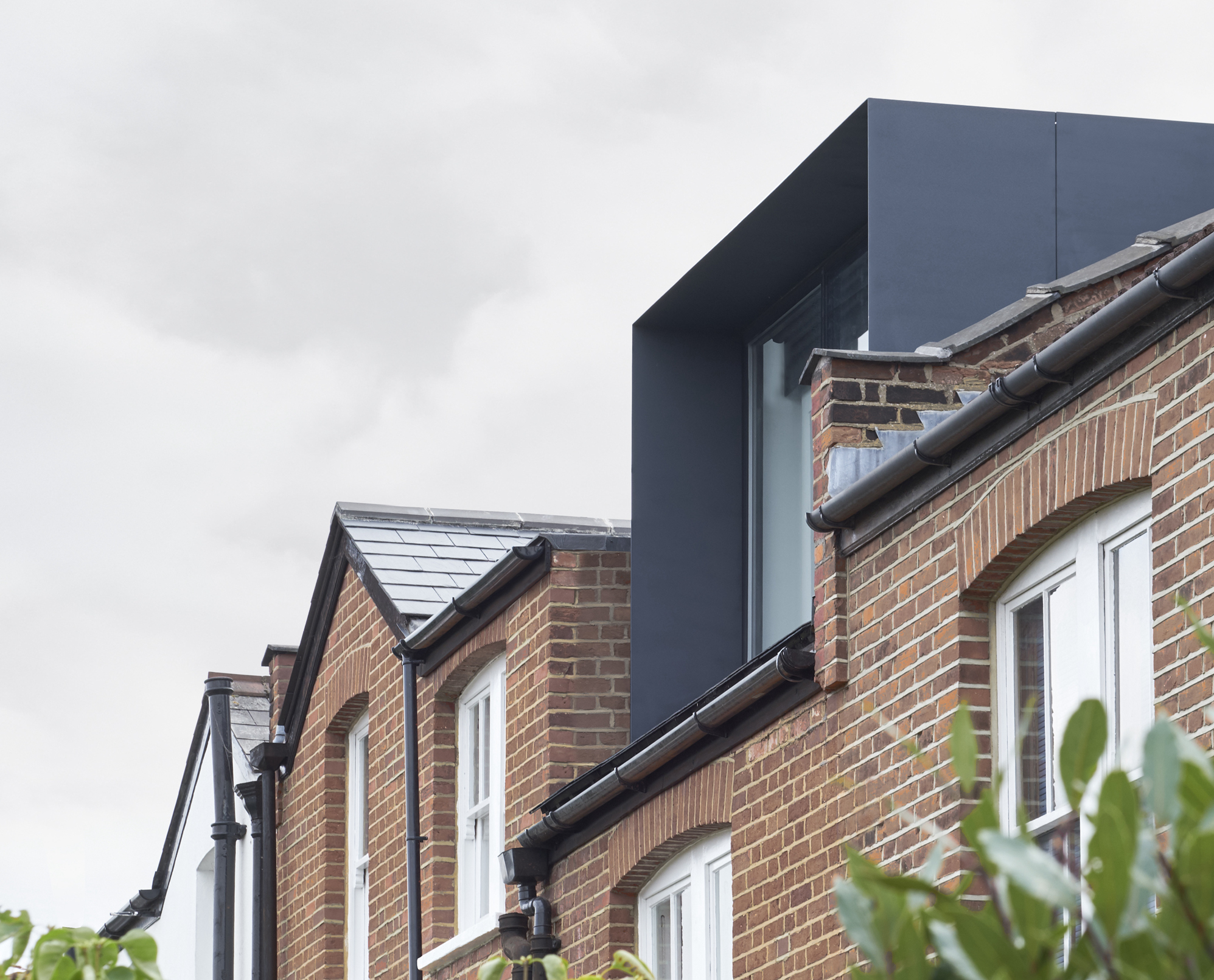
In most circumstances you will not need planning permission for a loft conversion, as the development will be covered by GPDO (permitted development). However, you should also check if your permitted development rights are restricted or have been removed (see below)*
Roof extension pictured above by Ben+Eoin, architect from Southwark, London. Click here to see more and shortlist them for your home project.
Buying with a loft conversion in mind?
Before you commit, an impartial pre-purchase appraisal through The Potential House can check feasibility, head height, roof type, PD limits and likely build costs without any follow-on design upsell. Think of it as the architectural equivalent of a survey — focused on design potential and planning risk so you can decide with confidence.
Planning permission for a loft extension or loft conversion?
A straight loft conversion should not usually require planning permission as you are not altering the external shape of your house. Adding rooflights or skylights can also be covered by GPDO (permitted development), so won’t require planning permission. However, you should also check if your permitted development rights are restricted or have been removed (see below)*
If you intend to extend your roof space as part of your loft conversion, planning permission may be needed.
Does a mansard roof extension need planning permission?
YES
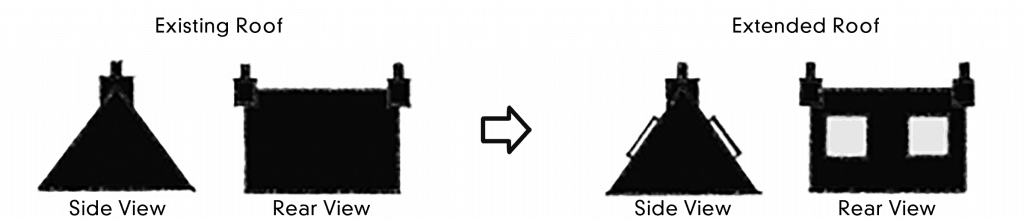
If you have a valley (aka butterfly or London) roof as in the diagram below, it will usually require a mansard roof extension, which will require planning permission.
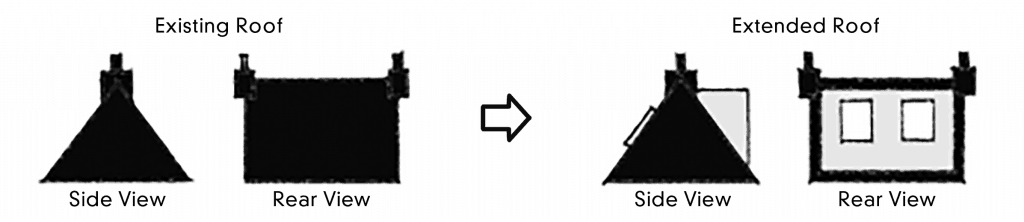
Does a rear dormer loft extension need planning permission?
NOT USUALLY
A rear dormer extension will usually be acceptable under GPDO (permitted development), and so not require planning permission. See the rules in the box below. However, if the dormer is on the principal elevation (i.e. fronts a road/path) it will need planning permission. Also check if your permitted development rights are restricted or have been removed (see below)*
Permitted development rules for loft conversions
1. An extension beyond the plane of the existing roof slope of the principal elevation that fronts a highway is NOT permitted development.
2. Materials to be similar in appearance to the existing house.
3. Cannot extend above the existing highest point of the house.
4. No verandas, balconies or raised platforms.
5. Any side-facing windows must be obscure glazed and non-opening unless any opening parts are more than 1.7m above the floor of the room in which they are installed.
6. Additional roof volume must not exceed 40m³ for terraced houses and 50m³ for semi-detached and detached houses (include any previous roof additions).
7. Roof extensions, apart from hip-to-gable ones, must be set back at least 20cm from the original eaves (measured along the roof plane).
Summarised from information provided by the Planning Portal. Please consult your local planning authority before undertaking works.
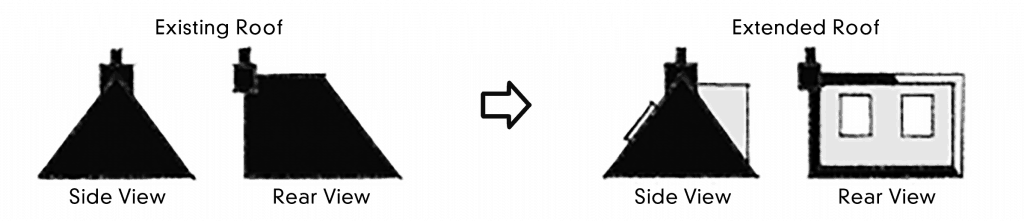
Does a HIP-TO-GABLE loft extension need planning permission?
NOT USUALLY
A hip-to-gable extension will usually be acceptable under GPDO (permitted development), and so does not require planning permission — see the rules above. Always check whether your PD rights are restricted or removed*
*Have your permitted development rights been restricted/removed?
There are situations where permitted development rights do not apply in your area or to your property:
- Your PD rights have been removed or restricted due to:
- The property is a flat or maisonette.
- You don’t own the whole property.
Do you need to “apply” for permitted development?
You are not required to submit a planning application for permitted development.
Certificate of Lawful Development (LDC)
To be completely sure your project meets PD guidelines and that PD rights apply, it’s usually a good idea to obtain a Lawful Development Certificate (ideally before construction). It gives peace of mind and future resale proof.
Do you need Building Regulations approval for a loft conversion?
Yes. It’s a legal requirement. Without approval, the council could require works to be opened up, remediated, or even rebuilt. For lofts, the most common route is a Building Notice to the council before work starts. Agree with your builder and/or architect who is responsible for submitting it. See our post on Building Control routes.
We’d strongly recommend working with an architect to ensure compliance (structure, fire safety, stairs, insulation, sound, and escape). If you’d like help finding the right architect, visit our home page or use the form below.
Ready to move from ideas to drawings?
Post your project on Design for Me to meet vetted residential architects who can take your loft from concept to completion — it’s fast, free and no obligation.
Helpful reads to plan your loft conversion
- How to plan a loft conversion – the dos and don’ts
- Loft conversion plans – where to start & Building Regs
- Average & minimum ceiling heights
- How much does a loft conversion cost?
Loft conversion – quick FAQ
Do I need an LDC (Lawful Development Certificate)?
No, but it’s recommended for certainty, conveyancing, and resale.
Can I do a front dormer under PD?
No — anything on the principal elevation fronting a highway requires planning permission.
How do I calculate PD roof volume?
Use external measurements of the new roof space added and include all previous roof additions since 1 July 1948 when checking the 40/50m³ limit.
What about conservation areas?
PD may be restricted or removed (e.g. dormers not allowed). Check Article 4 Directions with your LPA.
Flats and maisonettes?
PD rights for roof enlargements don’t apply. You’ll need planning permission.
What Building Regs typically affect lofts?
Structure (new joists/steel), fire protection & escape, stairs geometry, insulation & ventilation, and sound separation.
Pre-purchase checks?
Head height, roof type (cut vs trussed), stair position, PD context and likely costs. For impartial due-diligence before you buy, see The Potential House.
Loft conversion – FAQs
Do I need a Lawful Development Certificate (LDC) for a loft conversion?
No, it’s not mandatory. However, an LDC is strongly recommended to prove the works were lawful under permitted development for conveyancing and resale.
Can I build a front dormer under permitted development?
No. Any enlargement on the principal elevation that fronts a highway requires planning permission.
What is the maximum roof volume I can add under permitted development?
Up to 40m³ for a terraced house, and up to 50m³ for a semi-detached or detached house. All previous roof additions since 1 July 1948 count toward this limit.
Do permitted development rights apply in conservation areas?
They can be restricted or removed (e.g., via an Article 4 Direction). Always check with your local planning authority before proceeding.
Do flats or maisonettes have permitted development rights for loft conversions?
No. Flats and maisonettes do not benefit from householder permitted development rights for roof enlargements, so you’ll need planning permission.
Do I still need Building Regulations approval for a loft conversion?
Yes. Building Regulations approval is required for structure, fire safety and escape routes, stairs, insulation/ventilation, and sound separation.
What’s the difference between a dormer and a mansard in planning terms?
Rear dormers are often permissible under PD (subject to rules). Mansards change the roof shape significantly and typically need full planning permission.
Should I check feasibility before buying a house for a loft conversion?
Yes. Pre-purchase due diligence (head height, roof type, stair position, PD context, likely costs) helps avoid surprises. For impartial, no-upsell advice, consider The Potential House.
Get Matched with an Architect, Interior Designer or Garden Designer
Ready to get started? Post your project and we’ll match you with home design professionals – all over the UK – who are a perfect fit for your brief. It’s free, fast and no obligation.
- See who’s interested in your job
- Shortlist design pros
- Arrange consultations – for free!